On this page
- The takeaways, sorted by how sure we are
- Sunscreen is boring, and it matters most
- A retinoid has the strongest evidence among creams
- Early irritation is common, so watch it
- Dark spots are a different problem with a different drug
- What we put in the bottle
- Where the evidence gets thin, and your money leaks
- Botox and fillers work well, but not by mail
- Build it in three steps
- The question we can’t answer yet
Most anti-aging advice is noise piled on top of two things that work. Daily sunscreen and a nightly retinoid have the strongest evidence of anything you put on your skin. Sunscreen prevents the damage, and a retinoid partly reverses it. Everything else makes a small difference at best, and some of it is just packaging.
Here’s our position up front. Get those two right and you’ve captured most of the benefit there is to get. This guide covers what we offer, what we don’t, and where your money quietly leaks.
Sunscreen is boring, and it matters most
Ultraviolet (UV) light is the main cause of what people call aging skin. UVA and UVB reach the dermis, the deeper layer of your skin. There they create unstable molecules and switch on enzymes called MMPs. MMPs break down collagen and elastin, the proteins that keep skin firm. This is settled science, not a serum claim.
The wrinkles, sagging, and blotchy pigment we read as “old” are mostly built-up sun damage. That’s why sun-protected skin, like the underside of your forearm, looks decades younger than your face.
That fact is bad news for anyone selling creams. Nothing you apply reverses damage faster than daily sun keeps causing it. A broad-spectrum SPF 30 or higher, worn every day, is the most powerful item in this guide.
Reapplying matters more than the number on the bottle. SPF 50 applied once at 8am and forgotten protects less by noon than SPF 30 reapplied. Mineral filters (zinc oxide, titanium dioxide) sit on the surface and scatter light. Chemical filters absorb it and release it as heat. Both prevent photoaging when used properly, so the best sunscreen is the one you’ll actually wear every day. Routines fail because people skip them, not because of the filter chemistry.
Our position: if you do only one thing, do this. If you do two, add the retinoid below.
A retinoid has the strongest evidence among creams
Retinoids are forms of vitamin A that bind retinoic acid receptors (RARs) in your skin. That helps skin cells mature normally. More important for aging, it boosts collagen in the dermis and turns down the MMPs that break collagen apart. That’s a real drug effect, well beyond a nice feeling on your skin.
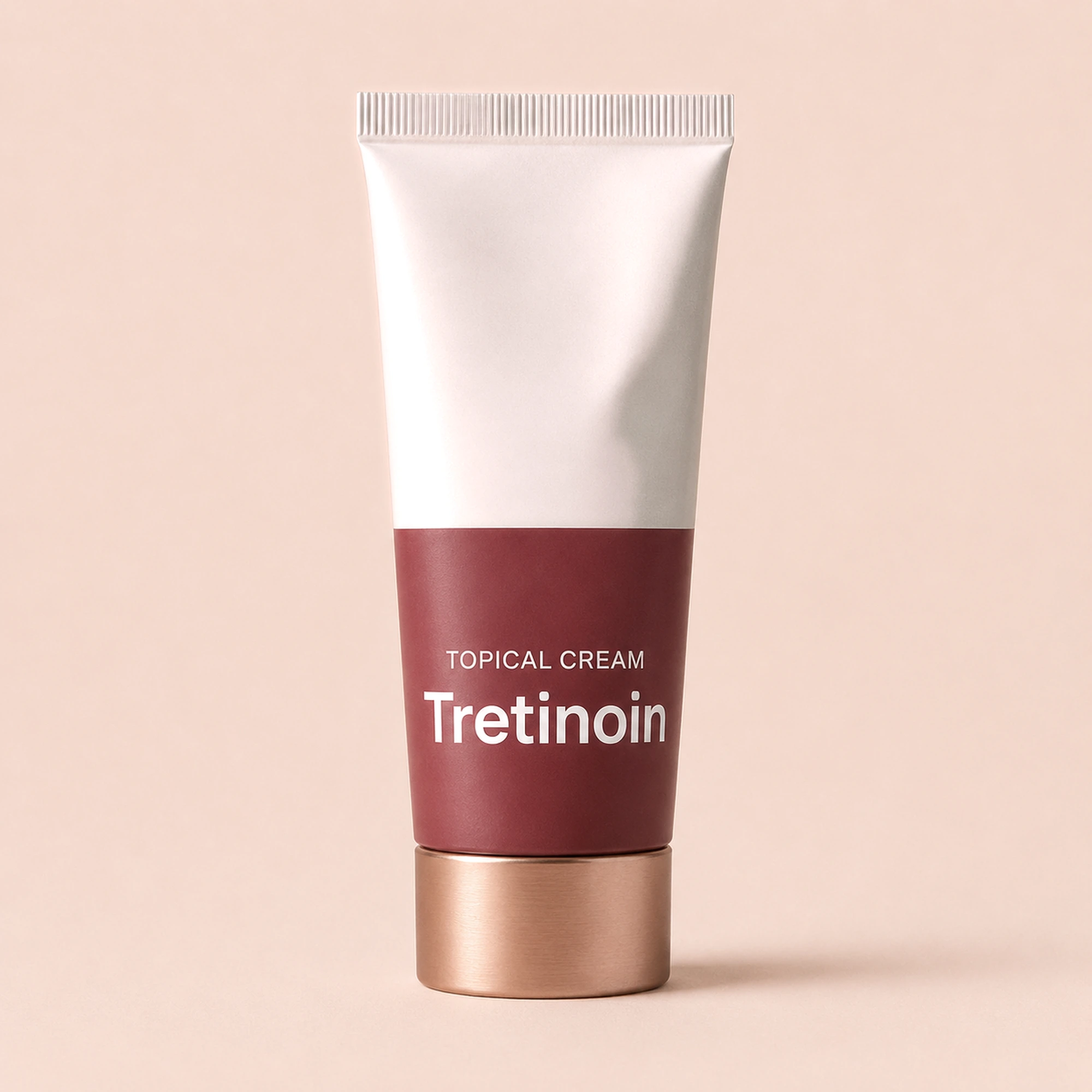
Certain brand-name tretinoin creams, like Renova, are FDA-approved for photoaging (skin aged by the sun). So is tazarotene cream (Avage). Tretinoin has the longest track record, so it’s the usual standard to measure others against.
The retinoid family runs from strongest to mildest, and they are not equal:
- Tretinoin: prescription only. It binds the receptors directly and has the strongest evidence. The ingredient detail is at /ingredients/tretinoin.
- Adapalene: lab-made and sold over the counter. A fair place to start.
- Retinol: sold over the counter, but your skin has to convert it first (retinol → retinaldehyde → retinoic acid) before it does anything. So it’s milder and slower. It’s fine for sensitive skin, but it isn’t as strong as tretinoin.
Keep your expectations in line with the biology. Your skin takes a few weeks to get used to it. Visible change in fine lines and tone takes months, because you’re waiting on the dermis to rebuild.
Apply it at night. Sunlight breaks tretinoin down, and it can make your skin more sensitive to the sun. That’s one more reason the morning SPF isn’t optional.
Early irritation is common, so watch it
New retinoid users often get redness, flaking, and stinging in the first few weeks. Many decide the drug is “too harsh” and quit. Some irritation is common early on. Speeding up skin cell turnover disrupts the skin barrier for a while, and mild irritation often settles as your skin adjusts. But irritation isn’t proof the drug is working. If it’s strong, your clinician should take another look.
So the answer is titration, which means easing in and using it more often over time. Start low and a few nights a week. For most people, how often you use it is the first thing to change, well before strength. If you can only handle it twice a week at first, that’s okay. Steady use over months beats a hard schedule you abandon in three weeks.
Here’s one common way to ease in. Your clinician may set a different plan for your exact product:
- Tretinoin 0.025%, two nights a week for two weeks.
- Then three nights a week for two weeks.
- Then every other night.
- Then every night, if you get there.
Move up only when the current step causes no trouble. Raise how often first. Raise the strength much later, only after months of nightly use without problems.
Use a pea-sized amount for the whole face, on dry skin, with moisturizer before and after. During the ramp, skip anything acidic and skip benzoyl peroxide on tretinoin nights. Wear sunscreen every morning without exception.
Don’t use tretinoin or other retinoids if you’re pregnant, trying to get pregnant, or breastfeeding, unless your clinician says it’s okay. Tell your clinician if any of these apply.
Irritation often peaks in the first few weeks. If it does, ask your clinician about dropping back a step before you quit on your own. Short-contact use, where you wash it off after a set time, is another option they may suggest.
Talk to your clinician if the irritation is severe, spreading, or blistering. That goes beyond the expected mild flaking. It can signal an allergic skin reaction (contact dermatitis) to an inactive ingredient. That’s a reason to change the formula, so don’t push through.
Dark spots are a different problem with a different drug
Fine lines and brown patches are different targets. Uneven pigment comes from overactive pigment cells making too much melanin. That includes melasma, sun spots, and marks left after acne. Hydroquinone works by blocking tyrosinase, the key enzyme your skin uses to make melanin. That’s why it lightens those specific spots, where a retinoid and sunscreen only help slowly. Dermatologists use it in short, supervised courses. Zappy doesn’t offer hydroquinone right now.
Short and supervised is deliberate. Using hydroquinone nonstop for a long time can, rarely, cause exogenous ochronosis, a blue-grey darkening of the treated skin. So agree on the course length with a clinician, and don’t treat it as a forever product.
Azelaic acid and niacinamide are gentler helpers. Azelaic acid also blocks tyrosinase and calms inflammation. Their effect on pigment is real but smaller, and the evidence behind them is thinner than for hydroquinone. Pigment also rewards prevention more than correction. Every one of these works better under strict daily sun protection, and melasma in particular comes back fast without it.
What we put in the bottle
Zappy’s tretinoin formula combines tretinoin with azelaic acid and niacinamide. It’s made by a compounding pharmacy at a strength your clinician chooses for your skin, and compounded medicines are not FDA-approved. Clinicians often start sensitive skin at a low strength and raise it only if your skin handles it.
Niacinamide may support the skin barrier and reduce the water loss that makes early retinoid use feel raw. Azelaic acid is used for pigment and breakouts. A combination isn’t automatically better than tretinoin alone. If this formula doesn’t suit your skin, your clinician can talk through other options.
A US-licensed clinician reviews your intake and sets your starting point. You’re not pulling a strength off a shelf and hoping.
Where the evidence gets thin, and your money leaks
Most brands won’t write this part.
- Vitamin C (L-ascorbic acid): the reason it might work is real. It’s an antioxidant, and your skin needs it to build collagen. Whether a given serum delivers enough stable vitamin C into your skin to matter is far less certain. These formulas also go bad in air, and the browning you see is the product breaking down. It’s reasonable to use, but not worth overpaying for.
- Peptides: sold as ingredients that signal your skin to make collagen. The idea makes sense. But the controlled studies in people showing a visible anti-aging effect are weak and short. We’d call it unproven. If it’s already in your routine, keep it, but don’t let it replace the retinoid.
- Collagen drinks, exosome serums, and most at-home “anti-aging” devices: we don’t recommend spending here yet. When the evidence catches up, we’ll change this line, and we mean that.
Here’s the honest ranking. Sunscreen and a retinoid do the work, and pigment treatments solve a specific second problem. Everything else adds very little, and you’re often overpaying for it.
Botox and fillers work well, but not by mail
Botulinum toxin (Botox) relaxes the muscles you use to make faces. It blocks the nerve signal that makes them tighten. That’s why it softens dynamic lines, the ones that come from movement, like frown creases. Fillers restore lost volume, usually with hyaluronic acid. Both work well in trained hands.
Both are also in-clinic injections that telehealth shouldn’t be mailing you. If you want either one, see a board-certified dermatologist or another qualified in-person specialist. If you’re weighing the two, see our comparison at /compare/botox-vs-fillers.
Build it in three steps
- Morning: Cleanser → vitamin C (optional) → SPF 30+. Stop there.
- Night: Cleanser → tretinoin (pea-sized, as often as your clinician sets) → moisturizer.
- Weekly: A gentle exfoliant if your skin tolerates it. Never on a retinoid night.
That’s the routine. The rest is product marketing.
The takeaways, sorted by how sure we are
- FDA fact: certain brand-name tretinoin creams and tazarotene are FDA-approved for photoaging. Compounded formulas are not FDA-approved. Daily broad-spectrum SPF and a retinoid have the strongest backing.
- Settled science: UV light ages skin by switching on MMP enzymes that break down collagen. Retinoids boost collagen by acting on RAR receptors. Hydroquinone lightens pigment by blocking tyrosinase.
- Standard practice: keep hydroquinone to short, supervised courses. With retinoids, raise frequency before strength.
- Our clinical opinion: peptides, vitamin C serums, and most anti-aging devices are optional at best. Don’t let them crowd out the two that work.
Ready to start? A clinician can review whether a compounded tretinoin plan fits you. Start at /quiz/.
The question we can’t answer yet
Here’s the honest gap. Nearly all retinoid research measures how skin looks over months. It scores fine lines, pigment, and sun damage on a scale. What we don’t have is long-term controlled data on prevention.
Say you start a retinoid in your 20s or 30s, before any visible change. Does that actually change how your skin ages, compared with starting once changes appear? “Collagen banking” is a marketing phrase, not a proven strategy. Until someone runs that ten-year comparison, we do the two things we’re sure about. Protect the skin from UV, and titrate a retinoid to what your skin tolerates.