On this page
Sleep probably matters for your results, but not in the way sleep-hack posts claim. No trial has tested whether sleeping more makes semaglutide or tirzepatide work better. What we do have is good evidence that short sleep raises hunger hormones, and one small, well-controlled study showing that on the same calorie deficit, short sleep changed what was lost: less fat, more lean mass. The medication doesn’t cancel either effect, so it’s worth protecting your sleep. The catch is that the medication itself can get in the way, mostly through your stomach at night.
What short sleep does to appetite
Two studies from 2004 set the baseline, and they answer different questions.
Taheri et al. (PLoS Medicine, 2004) looked at 1,024 adults in the Wisconsin Sleep Cohort. People who habitually slept 5 hours had about 15% higher ghrelin (the hormone that drives hunger) and about 15% lower leptin (the hormone that signals you have enough stored energy) than people who slept 8 hours. Shorter sleepers also had higher BMI. It’s observational, so it can’t prove sleep caused the difference.
Spiegel et al. (Annals of Internal Medicine, 2004) ran the experiment. Twelve healthy young men spent two nights with 4 hours in bed and two nights with 10 hours, under controlled conditions. After short sleep, leptin was 18% lower, ghrelin 28% higher, and self-rated hunger 24% higher. Small study, two nights, young lean men. It shows the direction clearly, and it doesn’t tell you the size of the effect in a 50-year-old on a GLP-1.
Semaglutide and tirzepatide act on the same hypothalamic and hindbrain appetite circuits that ghrelin and leptin feed into. A GLP-1 turns the volume down on hunger. Short sleep turns it back up from a different direction. Whether the drug fully overrides a bad night, partly overrides it, or doesn’t, nobody has measured. What you can say is that a short night adds hunger pressure the drug then has to work against.
Short sleep during a diet costs more lean mass
One small study makes sleep worth taking seriously during weight loss.
Nedeltcheva et al. (Annals of Internal Medicine, 2010) put 10 adults with overweight on the same calorie-restricted diet twice, for 14 days each, in a crossover design. Once they had 8.5 hours in bed, once 5.5 hours. Total weight loss was about the same both times. What changed was the composition. With 8.5 hours, they lost about 1.4 kg of fat and 1.5 kg of fat-free mass. With 5.5 hours, fat loss dropped to about 0.6 kg and fat-free mass loss rose to about 2.4 kg. Hunger was also higher on short sleep.
It was 10 people, two weeks, in a lab, without any medication. It has not been repeated in people on a GLP-1. So it doesn’t support a claim that good sleep means more fat loss on semaglutide. It supports something narrower: in a calorie deficit, short sleep may push the body to give up more lean tissue.
That matters more than usual on these drugs. DXA substudies from the GLP-1 trials show that a meaningful share of the weight lost is lean mass. The usual countermeasures are protein at about 1.2–1.6 g per kilogram of body weight per day and resistance training twice a week, covered in the GLP-1 food guide and preventing muscle loss on a GLP-1. Sleep is a plausible third lever, with weaker evidence than the other two. How much of that lean loss matters for long-term strength and function hasn’t been characterized yet.
One randomized trial points the same way. In Tasali et al. (JAMA Internal Medicine, 2022), 80 adults aged 21 to 40 with overweight who usually slept under 6.5 hours were randomized to a personalized sleep-hygiene session or to their usual sleep. The sleep-extension group slept about 1.2 hours more per night and ate about 270 fewer calories a day than controls over two weeks, measured with doubly labeled water rather than food diaries. Again: short, no medication, and intake rather than fat loss.
How much is enough? The American Academy of Sleep Medicine and Sleep Research Society consensus (Watson et al., 2015) recommends 7 or more hours a night for adults. That’s a general health recommendation, not a GLP-1 target, but there’s no reason to aim lower.
Why GLP-1s can wreck your sleep
The drug doesn’t appear to act on sleep directly, though that hasn’t been studied well. Most of what patients describe traces back to the same mechanism that makes the drug work: slowed gastric emptying.
Night reflux. A slow stomach still holds part of dinner when you lie down. Lying flat takes gravity away, and food and acid push against the valve at the top of the stomach. Heartburn, a sour taste, or a cough that wakes you at 2 a.m. is the classic pattern. The heartburn and reflux guide covers antacids and when reflux is a dose signal.
Nausea. It tends to peak in the days after a dose increase and fade as your stomach adapts. A full stomach at bedtime makes it worse.
Hunger at the wrong time. Two patterns are commonly reported, though neither has been studied as a sleep problem. Some people under-eat all day because the appetite is gone, then get genuinely hungry late in the evening. Others notice appetite creeping back near the end of the weekly dosing cycle. Either can make it hard to settle.
Bathroom trips. Drinking enough water on a GLP-1 is important, especially for constipation. But people who forget during the day often catch up in the evening, and then wake up to pee. The fix is to change when you drink, and keep the total.
A note on 3 a.m. waking. You’ll read that it’s a blood sugar crash. GLP-1s raise insulin only when blood sugar is high, so on their own they rarely cause low blood sugar. That changes if you also take insulin or a sulfonylurea such as glipizide. Then night sweats, a racing heart, or waking shaky can be real hypoglycemia, and your clinician needs to know, because those doses may need to come down.
An evening routine that targets the causes
Each step below maps to one of the causes above. The first two have the best support and cost nothing.
Stop eating about 3 hours before bed. The American College of Gastroenterology’s reflux guideline (Katz et al., 2022) recommends avoiding meals 2 to 3 hours before bed, and on a slow stomach the longer end makes sense. If dinner is your biggest meal, the bigger change is to move food earlier in the day. The meal timing and hydration guide walks through flipping your day so lunch carries the load.
Raise the head of the bed 6 to 8 inches. The same guideline recommends head-of-bed elevation for reflux at night. Use blocks under the bed legs or a foam wedge. Extra pillows don’t do the same thing: they bend you at the waist instead of tilting your whole torso.
If you’re hungry at night, have a small protein snack. A few bites, not a meal: a piece of cheese, some Greek yogurt, a boiled egg. It takes the edge off without refilling a slow stomach, and it counts toward your protein target. Keep it early enough and small enough that you aren’t lying down on it.
Stop caffeine by early afternoon. Caffeine’s half-life averages about 5 hours, and it varies a lot between people. Drake et al. (Journal of Clinical Sleep Medicine, 2013) gave 12 healthy sleepers 400 mg of caffeine 0, 3, or 6 hours before bed. Even at 6 hours, it cut measured sleep by more than an hour. For a 10 or 11 p.m. bedtime, a cutoff around 1 or 2 p.m. is a sensible default. Remember that tea, cola, pre-workout drinks, and some pain relievers contain caffeine too.
Move your water earlier. Front-load fluids: most of your intake by late afternoon, sips after dinner.
Keep the phone out of the bedroom. The evidence here is weaker than for the steps above. A lab study, Chang et al. (PNAS, 2015, n=12) found that reading on a light-emitting e-reader before bed delayed melatonin and made it take longer to fall asleep, compared with a printed book. How much this matters outside the lab is less clear. The simpler reason is that a phone in reach makes it easy to stay up. A cheap alarm clock removes the excuse.
Melatonin and magnesium
Melatonin can help with sleep timing, such as jet lag or a delayed body clock. It does nothing for reflux, nausea, or a full bladder, so it won’t fix the GLP-1-specific problems. Magnesium is widely recommended for sleep, and the trial evidence behind it is thin and inconsistent. If your kidneys are healthy, it’s unlikely to hurt. Fix the causes first. If you take other medications, check any supplement with your clinician, since magnesium can interfere with absorption of some antibiotics and thyroid medicine.
When poor sleep needs a clinician
Some sleep problems aren’t habits. See a clinician if you have:
- Signs of sleep apnea: loud snoring, pauses in breathing or gasping that a partner notices, morning headaches, or heavy daytime sleepiness despite enough hours in bed. Obstructive sleep apnea (OSA) is common with obesity, and it’s diagnosed with a sleep study.
- Reflux that wakes you or forces you to sleep propped up. Don’t wait for it to settle. It can mean your dose needs to hold or step back, which is your clinician’s call.
- Symptoms of low blood sugar at night if you also take insulin or a sulfonylurea.
- Insomnia lasting more than a few weeks, low mood, or anxiety that keeps you up. These deserve treatment in their own right.
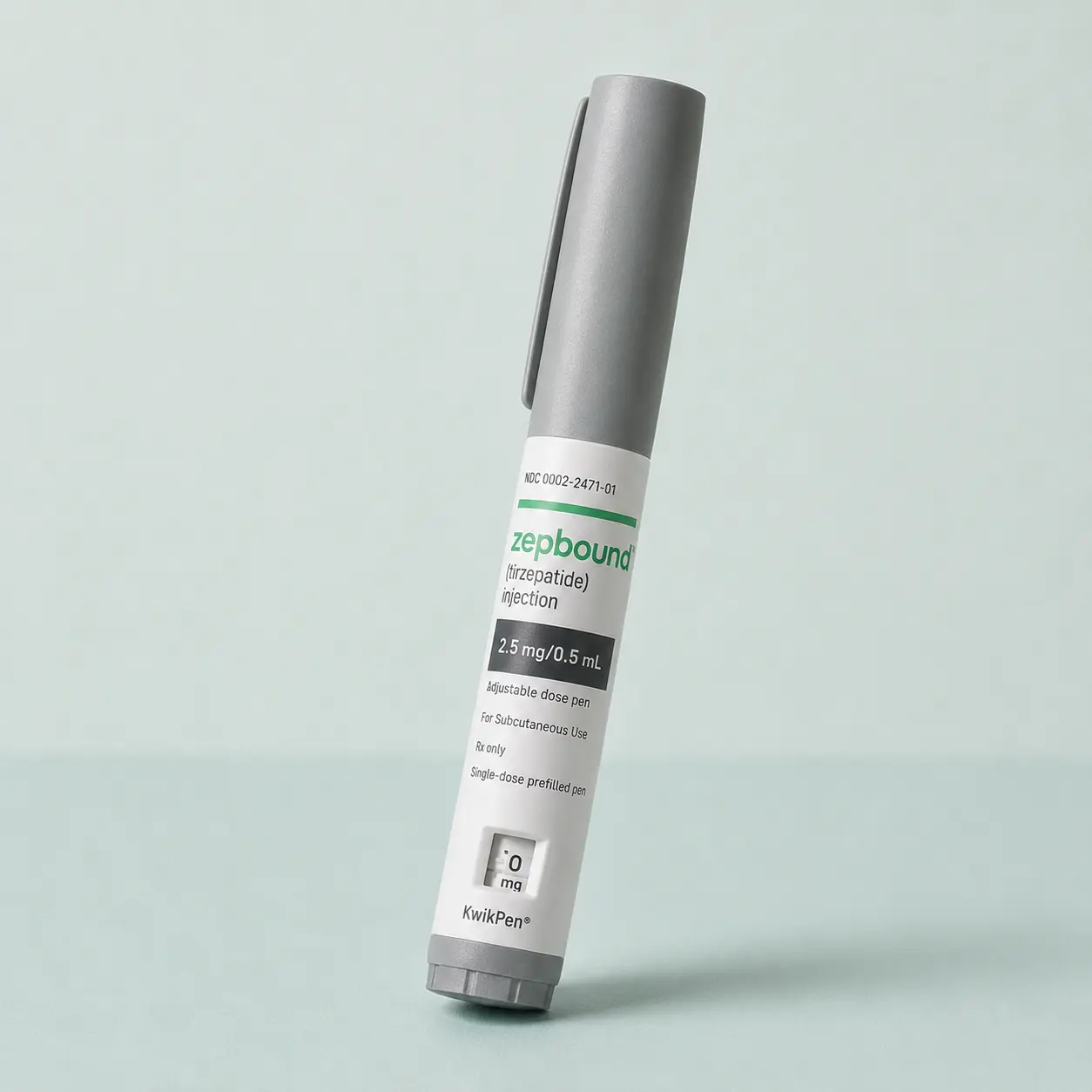
If sleep apnea is the problem, weight loss helps it, and one GLP-1 now has a specific approval. Zepbound (brand-name tirzepatide) is FDA-approved for moderate-to-severe OSA in adults with obesity. The approval rests on SURMOUNT-OSA (Malhotra et al., NEJM 2024, n=469), two 52-week trials in adults with obesity and moderate-to-severe OSA. In people not using CPAP, brand-name tirzepatide (Zepbound) cut the apnea-hypopnea index (breathing interruptions per hour) by 25.3 events, 20.0 more than placebo. In CPAP users, it fell by 29.3 events, 23.8 more than placebo. That approval applies to the brand-name drug. The medicine doesn’t automatically replace CPAP or other OSA care. If you think you have OSA, get the sleep study first; details on the branded option are on the Zepbound page.
What we still don’t know
The key experiment hasn’t been run. No one has randomized people on semaglutide or tirzepatide to sleep extension versus usual sleep and measured body composition by DXA over months. Nedeltcheva’s result (more lean mass lost on short sleep) comes from 10 people over two weeks without a drug. We don’t know whether a GLP-1 blunts that effect, leaves it alone, or makes it worse. A GLP-1 trial with a sleep-extension arm and DXA at 6 or 12 months would settle it. If short sleep turned out not to change body composition on the drug, sleep advice here would shrink to the reflux and nausea steps above.
If you’re on a compounded version
Compounded semaglutide and tirzepatide are not FDA-approved for any use, and they have no trials of their own. The trial findings were measured on the brand-name products.