On this page
Semaglutide and tirzepatide often change your appetite within the first week or two, but weight loss builds over months. The dose climbs slowly, so you spend the first 16 to 20 weeks working up to the full dose. In the main trials, weight kept coming off for more than a year before it leveled out.
Why the dose climbs slowly
Both drugs start low and go up about every 4 weeks. This is called titration. Each step gives your gut a month to adjust to a slower stomach before the next one.
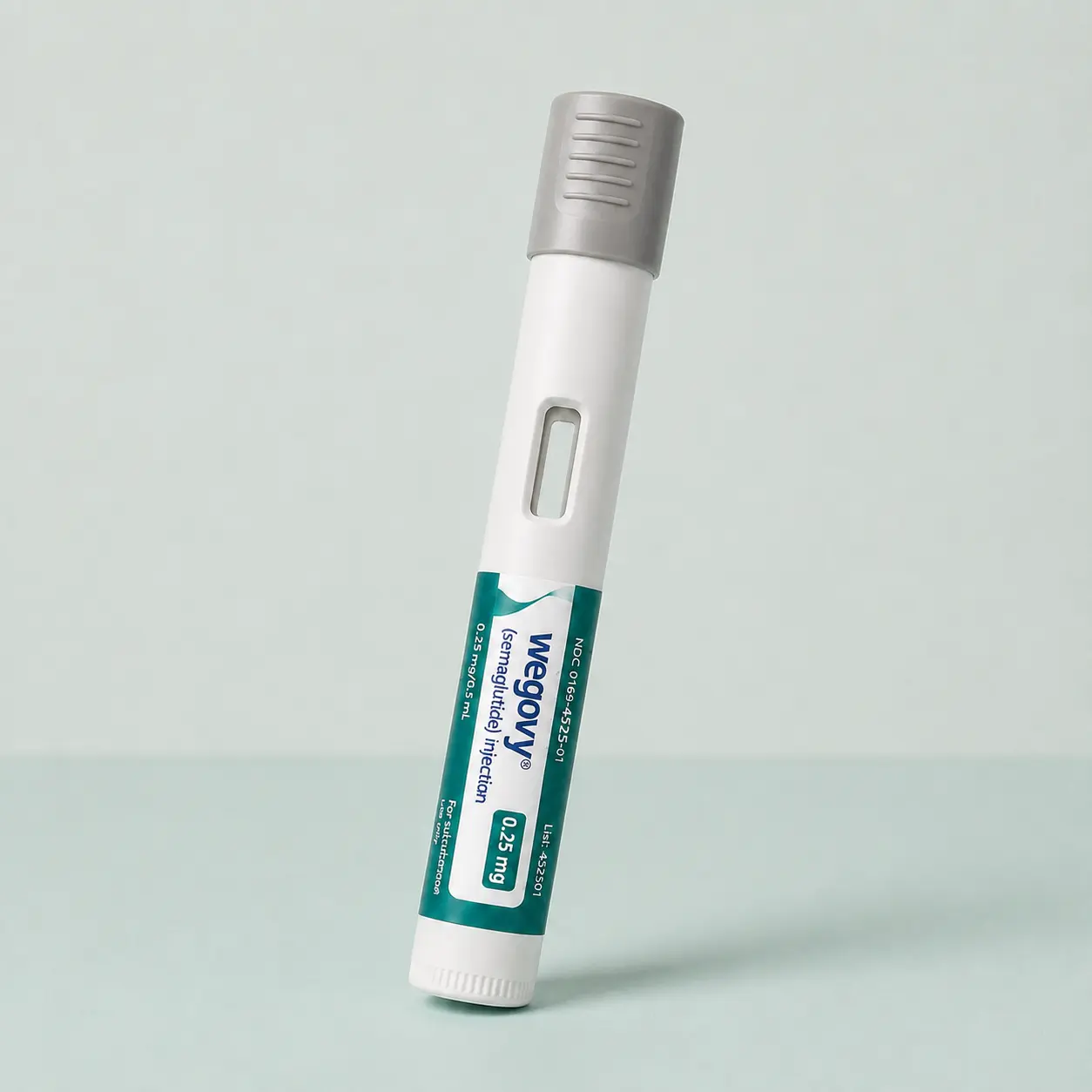
- Semaglutide (Wegovy label): 0.25 → 0.5 → 1.0 → 1.7 → 2.4 mg weekly. At the label pace you reach 2.4 mg around week 17, so about 16 weeks of climbing.
- Tirzepatide (Zepbound label): starts at 2.5 mg and goes up 2.5 mg at a time toward a maintenance dose of 5, 10, or 15 mg. Reaching 15 mg takes about 20 weeks.
The starter doses are there to build tolerance. If side effects slow the climb, everything after that shifts later too. The first four weeks page covers the starter month week by week.
What the trials show over time
The best timeline data come from the brand-name drugs.
STEP 1 (Wilding et al., NEJM 2021) followed 1,961 adults on Wegovy (semaglutide 2.4 mg). Average weight loss was 14.9% at 68 weeks, compared with 2.4% on placebo. The weight curve fell steadily and reached its low point around week 60.
The climb itself isn’t wasted time. In the 20-week run-in of STEP 4 (Rubino et al., JAMA 2021, 902 adults), people titrating up to brand-name semaglutide (Wegovy) 2.4 mg lost about 10% of their body weight on average before any of them had spent long at the full dose. Loss is slowest in the first month on the starter dose and adds up from there.
SURMOUNT-1 (Jastreboff et al., NEJM 2022) followed 2,539 adults on Zepbound (tirzepatide). At 72 weeks, average loss was 15.0% on 5 mg, 19.5% on 10 mg, and 20.9% on 15 mg, compared with 3.1% on placebo. The dose you end up on matters. How the two drugs compare in more detail is on semaglutide vs tirzepatide.
These are averages. Some people lost much more and some lost much less, and neither trial can tell you which group you’ll be in.
Signs it’s working before the scale moves
Both drugs slow gastric emptying (how fast food leaves your stomach) and act on appetite circuits in the brain. You’ll usually notice that before you see it on the scale:
- Portions shrink on their own. You feel full sooner and stop earlier without trying.
- Food noise goes quiet. You think about food less between meals. More on that in food noise.
- Cravings lose their pull. The evening snack feels optional.
How soon this shows up varies. Some people notice it in days, and others don’t until a higher dose. If you don’t notice much early on, that alone isn’t a reason to raise the dose. Your clinician looks at the whole picture.
What affects how fast it works
- The dose you reach. SURMOUNT-1 shows the dose-response plainly for brand-name tirzepatide (Zepbound): 15.0% on 5 mg vs 20.9% on 15 mg.
- Slowing titration for side effects. The labels allow holding a step for another four weeks if a dose isn’t tolerated. That’s a reasonable trade for less nausea, but it pushes the full dose later. Dose changes are your clinician’s call.
- Starting weight. The trials report percentages. The same 10% is 30 pounds at 300 and 18 pounds at 180, so a heavier person sees the scale move faster in pounds.
- Protein and strength training. These change what you lose more than how fast. Both trials paired the drug with diet and activity counseling, and DXA substudies show a meaningful share of GLP-1 weight loss is lean mass. Protein around 1.2–1.6 g/kg a day and resistance training twice a week are the usual countermeasures. Long-term data on muscle and physical function in GLP-1 users aren’t in yet. See protein targets.
- Missed doses. Skipping shots lowers your drug level and can interrupt titration. The missed-dose guide covers what to do.
To see what a realistic curve looks like for your own numbers, try the weight loss timeline tool.
If you have type 2 diabetes
Blood sugar runs on a different clock. These drugs boost insulin release mainly when blood sugar is raised (the effect is glucose-dependent), and that doesn’t wait for weight loss. So home glucose readings can shift before your weight does, though how early depends on the dose you’re on. A1C reflects about three months of blood sugar, which is why it’s usually rechecked around then.
If you take insulin or a sulfonylurea, adding a GLP-1 raises the risk of low blood sugar, and those doses often need adjusting. Plan that with whoever manages your diabetes before you start.
When slow progress is expected, and when it isn’t
Slow progress is normal during the climb. Six weeks in on 0.5 mg with little change on the scale is on schedule.
It’s worth raising with your clinician when all of these are true, using the criteria from semaglutide not working:
- You’ve been on 1.7 or 2.4 mg (or the highest dose you can tolerate) for at least eight weeks.
- You haven’t missed doses, and your storage and injections check out.
- Your appetite really hasn’t changed.
- Your scale, waist, and clothes haven’t changed since you started.
Also contact your clinician sooner if side effects are keeping you from moving up a dose, or if you can’t eat enough protein and fluid. Both slow everything else down, and both are worth solving early.
If you’re on a compounded version
Compounded semaglutide and compounded tirzepatide are not FDA-approved, and they have no trials of their own. The trial findings were measured on the brand-name products. Zappy also offers FDA-approved brand-name options: Wegovy, the Wegovy pill, and Zepbound.
What to do now
Write down your current dose, how many weeks you’ve been on it, and whether your appetite has changed. Take a waist measurement too. Those numbers tell you where you are on the timeline better than the scale does alone.
Not started yet? The five-minute quiz is where Zappy begins, and a clinician reviews every case within 24 hours.